
After an Unexpected Death: A Step-by-Step Guide for Families

When a loved one passes away suddenly, life can change in an instant. Along with the grief of losing someone you love comes a series of phone calls, unfamiliar procedures, and questions you never expected to face.
Although every situation is different, you may have many of the same questions: Who is in charge right now? What happens next? What caused your loved one’s death? When can you start making funeral arrangements? How long will the process take?
This guide is designed to make the process easier to navigate by explaining what may happen next, what questions to ask along the way, and what options may be available to you.
What Happens Immediately After an Unexpected Death?
In the first few hours after an unexpected death, several professionals and agencies can be involved, including hospital staff, emergency medical services (EMS), law enforcement, and the medical examiner or coroner’s office.
What happens next depends in part on how and where the death occurred:
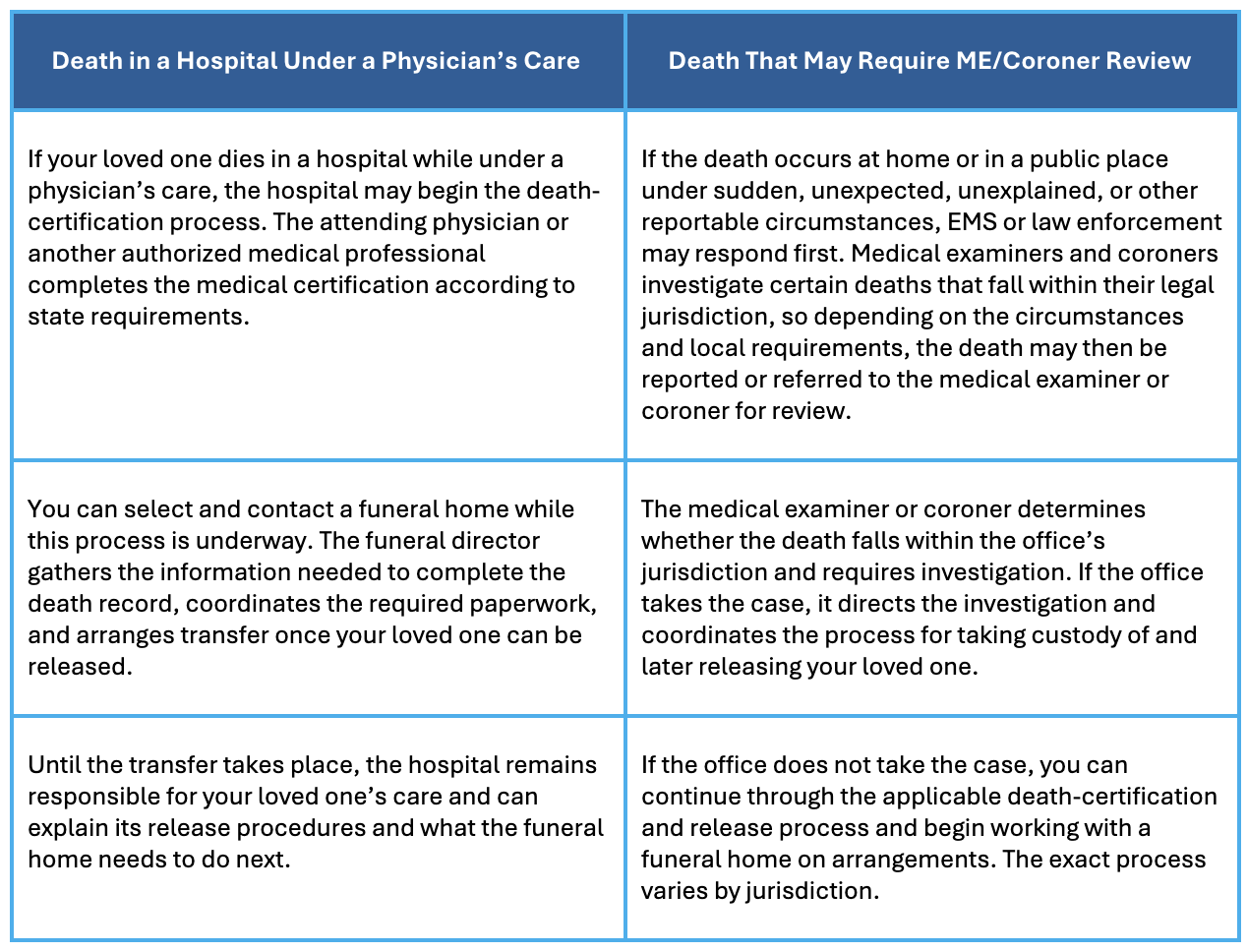
For families whose loved one’s death is referred to the medical examiner or coroner, there is an additional decision point before the process moves forward.
If the Death Is Referred to the Medical Examiner or Coroner
What happens next depends on whether the office accepts the case for investigation.
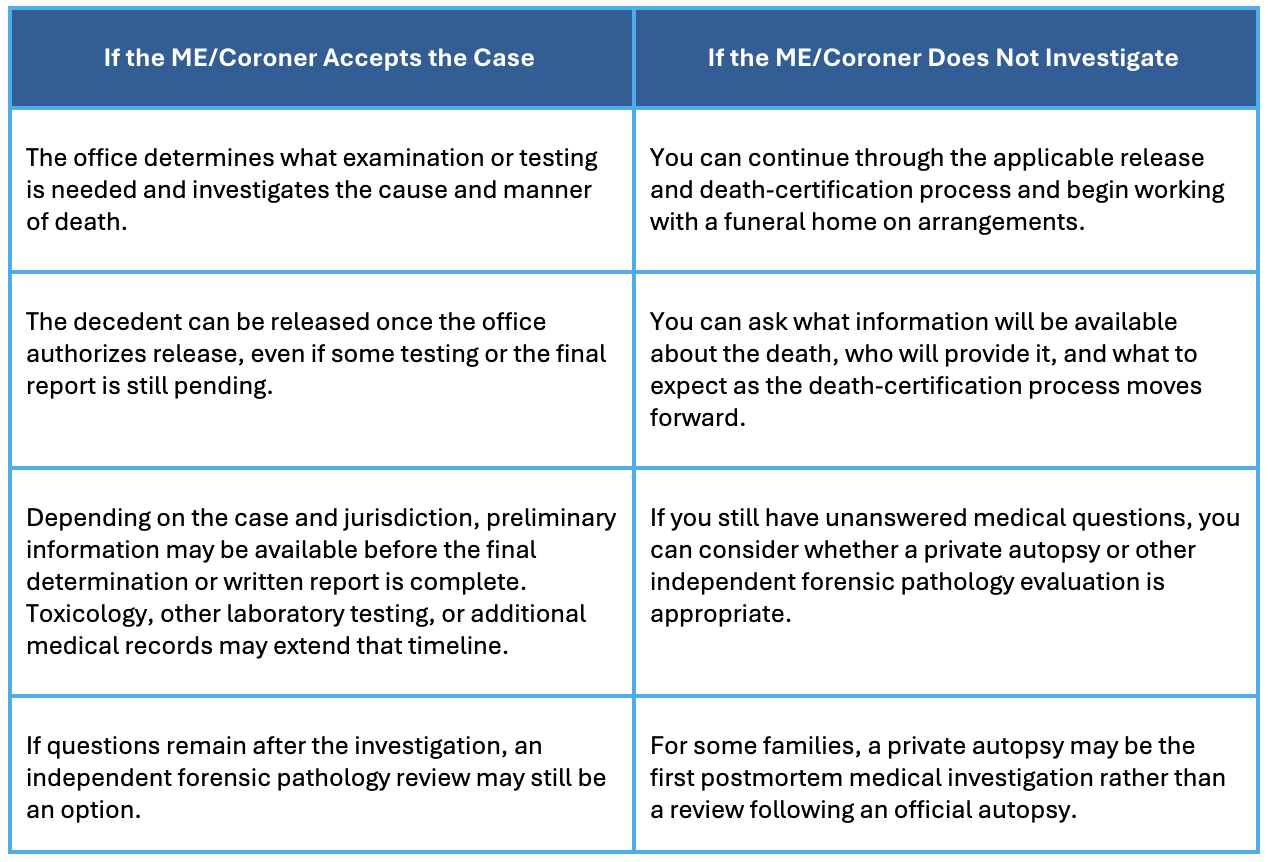
Whether your loved one’s death is handled through a physician’s care or involves a medical examiner or coroner, you can begin thinking about funeral arrangements before every medical or administrative step is complete. When and how the funeral home becomes involved depends on the circumstances and any applicable release requirements.
Getting Started with Funeral Arrangements
You can contact a funeral home before your loved one is released. Beginning funeral planning and the funeral home taking custody of your loved one are two separate steps:
Finding and contacting a funeral home: If you do not already have one, you can contact local funeral homes to ask about availability and next steps. Tell them where your loved one is currently located and whether a hospital, medical examiner, or coroner is involved.
Beginning funeral planning: You can speak with the funeral home about the services you are considering, provide the information needed for arrangements, and discuss timing and next steps. You do not need to wait for the physical transfer of your loved one to begin these conversations.
Transfer to the funeral home: Once you have selected a funeral home and provided any authorization required for release, the funeral home can coordinate the transfer of your loved one. Who it coordinates with depends on who currently has custody. If your loved one is at a hospital or other facility, the funeral home works with that facility on the release and transfer. If a medical examiner or coroner has taken the case, the funeral home coordinates with that office after release is authorized. Specific requirements vary by jurisdiction and facility.
What You Can Do
Ask what information or authorization the funeral home needs from you and whether there is anything you need to complete before transfer can occur.
Confirm who currently has custody of your loved one, who must authorize release, and how the funeral home will coordinate the transfer.
Ask about timing and share any time-sensitive medical questions or concerns before burial or cremation.
As you begin making arrangements, consider whether there are medical questions that need to be addressed before burial or cremation.
Before Burial or Cremation: Are There Unanswered Medical Questions?
Before proceeding with burial or cremation, consider whether you still have unanswered medical questions about your loved one’s death or need additional information. You may already have medical findings to work from, or no postmortem examination may have been performed. Reviewing the information you already have can help you determine whether another step may be appropriate.
What to Consider
What questions about your loved one’s death remain unanswered?
What medical information or findings do you already have?
Has an autopsy or other postmortem examination already been performed?
Are you planning burial or cremation soon?
These questions can help you identify what information is still missing and what options may be worth exploring before you move forward.
When Questions Remain: Understanding Your Options
If questions remain, the next step depends on what is still unclear and what information is already available. Some families need more clarity about the cause of death or the medical care their loved one received. Others may need help understanding existing findings or determining whether further testing could provide additional information.
Private Autopsy: If no postmortem examination has been performed, or questions remain after an earlier investigation, a private autopsy can provide additional medical information about the death.
Independent Pathology and Medical Record Review: If medical records, autopsy findings, or other medical information already exist, an independent review can offer another medical perspective and help clarify the information already available.
Additional Postmortem Testing: Genetic testing, toxicology, and specialized pathology evaluations can address specific medical questions that may require information beyond the records or findings already available.
EPIARX offers all three of these services and can help you understand which option may be appropriate based on your circumstances, the information already available, and the questions you are trying to answer.
If you’d like to learn more about these options, we’ve put together two additional guides to help: Private Autopsy vs. Medical Examiner: What Families Should Know and Additional Postmortem Testing: Genetic, Toxicology, and Specialized Autopsy Evaluations.
Navigating the days after an unexpected death can feel overwhelming, especially when so much is unfamiliar. We hope this guide gives you greater clarity and confidence as you move through the process.
If you still have questions about your loved one’s death, the EPIARX team is available to provide guidance based on your family’s circumstances.
Private Autopsy Coordination and Forensic Pathology Support
EPIARX supports families, funeral homes, and referring professionals in select jurisdictions across the United States. Availability may vary depending on state authorization requirements, forensic pathology resources, and transportation logistics.
Our team currently coordinates services in jurisdictions including:
East Coast: Connecticut (CT), Washington, D.C. (DC), Delaware (DE), Florida (FL), Massachusetts (MA), Maryland (MD), North Carolina (NC), New Hampshire (NH), New Jersey (NJ), New York (NY), Pennsylvania (PA), Virginia (VA), and West Virginia (WV).
West & Central Regions: California (CA), Colorado (CO), Hawaii (HI), Nevada (NV), Texas (TX), Oklahoma (OK), and Washington (WA).
Visit our Support Center, explore our FAQs, or connect with our Care Team for personalized guidance and support.
This article is for educational purposes only and is not medical or legal advice.