Private Autopsy vs. Medical Examiner: What Families Should Know

After the unexpected death of a loved one, families are often faced with unanswered questions. In some cases, a medical examiner may investigate the death automatically. In others, families may wonder whether they can request an independent autopsy for clarity.
Understanding the difference between a medical examiner investigation and a private autopsy can help families make informed decisions during a difficult time.
When a Medical Examiner is Involved
In many states, certain types of deaths must legally be reported to a medical examiner or coroner for review. This commonly includes sudden or unexpected deaths, fatal accidents, deaths without a physician present, deaths occurring in custody, or situations where the cause of death is unclear.
According to the CDC, medical examiner and coroner systems are responsible for investigating deaths that may affect public health or involve legal concerns, including injury-related or unexplained deaths.
Once a case falls under the medical examiner’s jurisdiction, the office determines whether additional investigation or an autopsy is necessary. The timing of the examination, release of the body, and scope of the investigation are generally controlled by the medical examiner’s office rather than the family.
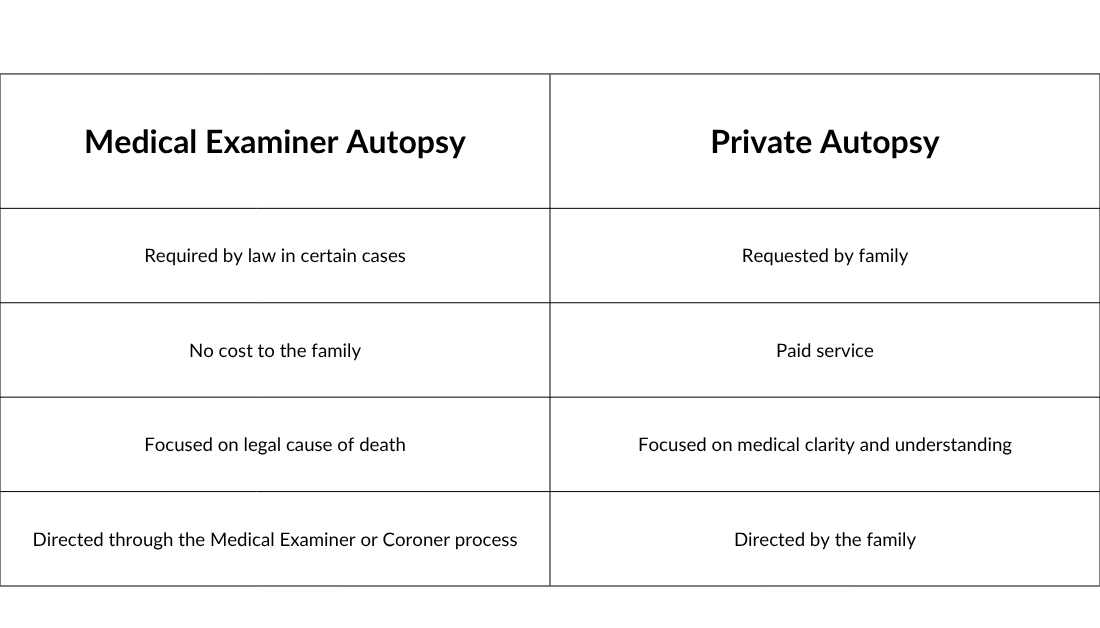
The primary purpose of a medical examiner autopsy is to establish the official cause and manner of death for legal, public health, or public safety purposes.
What is a Private Autopsy?
A private autopsy is an independent postmortem examination requested and authorized by a family rather than ordered by a government agency. These examinations are typically performed by a licensed forensic pathologist and may take place at a hospital, private facility, or medical institution depending on the circumstances and location.
Unlike a medical examiner autopsy, which is conducted for legal or public safety purposes, a private autopsy is usually requested to help families obtain additional medical clarification or a second opinion regarding the cause of death.
Families may consider a private autopsy when:
The cause of death remains unclear
They would like a second medical opinion
They have questions about the medical care provided
They are seeking more detailed findings than those included in an official investigation
Religious, personal, or family concerns remain unresolved
Because private autopsies are independently arranged, costs are generally paid by the family or requesting party.
Can a Family Request a Private Autopsy After a Medical Examiner Investigation?
In some situations, yes. Families may still seek an independent private autopsy even after a medical examiner has completed an examination. This may occur when additional medical clarification is desired or when families are seeking a second opinion regarding the findings.
Availability and timing may depend on state laws, release procedures, and coordination with the funeral home or medical facility.
What Different Approaches Should Be Taken
What Families Should Know
If a family is considering a private autopsy, there are several practical details to keep in mind.
Authorization Matters Private autopsies generally require permission from the legal next of kin, typically a spouse, parent, or adult child, though laws may vary by state.
Timing is Important While private autopsies are often arranged within the first few days after death, timing may vary depending on the circumstances.
Coordination is Required If the body is at a funeral home, arrangements often involve coordination with a funeral home for transportation, release procedures, timing, and viewing considerations.
Some families also seek a private autopsy after a medical examiner declines to perform one or after unanswered questions remain following an official investigation.
At EPIARX, we work alongside funeral homes and families when additional forensic pathology support or private autopsy guidance is needed. Our role is to help provide clarity, coordination, and professional medical insight during complex and often difficult situations.
Families considering a private autopsy should consult with qualified professionals regarding timing, authorization requirements, and available options in their state.
Private Autopsy Coordination and Forensic Pathology Support
EPIARX supports families, funeral homes, and referring professionals in select jurisdictions across the United States. Availability may vary depending on state authorization requirements, forensic pathology resources, and transportation logistics.
Our team currently coordinates services in jurisdictions including:
East Coast: Connecticut (CT), Washington D.C. (DC), Delaware (DE), Florida (FL), Massachusetts (MA), Maryland (MD), North Carolina (NC), New Hampshire (NH), New Jersey (NJ), New York (NY), Pennsylvania (PA), Virginia (VA), and West Virginia (WV).
West & Central Regions: California (CA), Colorado (CO), Hawaii (HI), Nevada (NV), Texas (TX), Oklahoma (OK), and Washington (WA).
Visit our Support Center, explore our FAQs, or connect with our Care Team for personalized guidance and support.
This article is for educational purposes only and is not medical or legal advice.